Know Any Literary Animal Lovers?

Hi there PureJeevan readers! We wanted to let you know that Jim's new novel CHROO is available on Amazon. It's a crazy adventure involving a billionaire heiress, her Chihuahua BFF ("Chroo") and a host of human and animal characters. Find out more on Amazon! Here are some links:

Jim here with a weird little story for today... I was at a business seminar early this morning and someone I know came up behind me at the buffet and said, "I'm getting in line behind you to see what you eat. You've lost weight and I want to lose weight, too."
"Well, it's no secret," I replied. "Just chow down on all of this great fruit they have." (I'd already piled my plate high with honeydew, cantaloupe, pineapple, and strawberries.)
Many times we are asked about our grocery bill---how much do we spend each month on eating a raw, vegan diet? It's not something that's easy to answer, though. If we just blurted the amount out, people would be shocked (at a minimum) and insist that there's no way possible they could ever eat a raw diet because they can't afford it.
Our monthly expense at the grocery store has continued to climb since I first began eating raw foods. At this point, now that Jim is eating 100% raw, as well, our monthly expense has more than doubled from the time when it was only me eating 100%. That's a huge increase in money being spent each month. But, you know what? It's okay! Yes, I said it's okay that our expense has more than doubled and I'll tell you why after you take a look at what we purchased last week for our home.

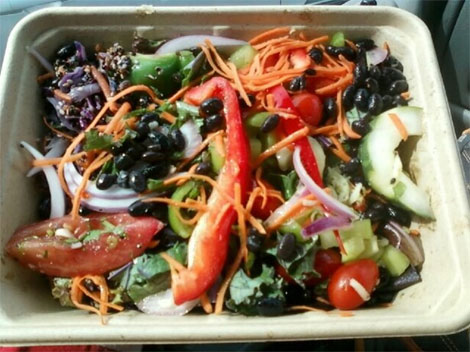
Jim here... As I hinted at last week, I decided to try changing things up a bit and seeing what I thought of it. The salad you see above included the first cooked food I've had in more than two years. If you look closely, you can see that I sprinkled on a few spoonfuls of black beans. Also, in the upper left corner, there's a small spoonful of quinoa. I don't want to give the wrong impression here: ?This blog will certainly remain a major go-to source for raw food nutrition information. It's just that, today, I want to talk about experimentation a little bit.
First, I think it's generally healthy to experiment with your diet -- especially when you get the sense that something isn't working in your current diet. The fact is, diet is a dynamic thing, not a static aspect of your life. It has to be this way because so many factors affect our physiology on a day-to-day basis. Off the top of my head, these include the facts that:
Read more: Experimentation: The 95% Raw Salad... A Good Idea or Not?

 Day 8:
Let's focus on creativity for a bit. This is an area where many men have been comfortable expressing a feminine quality, especially when done through art and music. I say many, because we all know at least a few men who were raised to believe that a strong, powerful man doesn't spend his time with such frivolous things. Instead, he works hard to earn an income to support his family. In the past, and still sometimes today, creative men were viewed as weaker and less masculine, not practical and in control. The feminine quality of creativity was, however, encouraged in women who were afforded more time for such "frivolity."

There is a lovely blanket of quietness covering Pittsburgh.Everything has been cancelled for the evening and people are staying home.Do you ever wonder what others do with their lives, how they spend their time when they are away from the rest of society and closed up in their own homes? I'm always curious---I think people are fascinating!


Jim here again... What do you think of that montage of vintage cigarette advertisements ! Knowing what we now know about cigarettes, it's tough to believe that such ads could have existed only 50 years ago, but the campaigns were real. Did doctors actually see no harm in cigarettes? Were there no pulmonary specialists back then who thought that habitually inhaling smoke might not be such a healthy idea Who knows... ?As I like to believe when it comes to doctors, even though they're quite oblivious to the harmful effects that chemicals have on our bodies, they do seem to mean well (in their own deluded ways). So, I don't hold it against them so much as I now hold it against individuals to think for themselves and challenge healthcare practitioners.
In any case, whether or not there is an advertising campaign attached to a new consumer product, it stands to reason that when a product is introduced into the marketplace, manufacturers should have a responsibility to ensure that the product is safe, and consumers should likewise have a reasonable expectation that the product is safe. Only, it doesn't always work that way, does it?

Jim here with another exciting installment of Weird Wednesday. (What, you thought that just because Wendi is out of town this week, we'd have no Weird Wednesday )
In any discipline, I think it's important to consider the entire argument in taking a stance on a given issue. Examine each issue from both sides (pro and con) -- and then make the best choice you can. That makes sense, right?
Welcome to Episode 4 of Know Your Food. Wow, the PEAR episode is here at last! Aren't you thrilled to know that? Of ALL of the fruits, veggies, nuts, seeds, herbs, etc. in the knon world, we finally got to the wonderful pear. Well, it's no surprise, when you think about it. After all, sweet, mild pears are usually among the first fruits fed to babies. So, chances are, you were fed them, too, as a toddler. So, let's dig in, shall we?
Pears contain water-soluable fiber (pectin), Vitamin A, Vitamin B1, Vitamin B2, Vitamin C, Vitamin E, Copper, Potassium, Posphorous, Folic Acid, Niacin, Iron, Magnesium, Sodium, Sulphur, Calcium, and more! They lower your blood pressure, releive inflammation, lower cholesterol via pectin, calm the stomach, cool the body, prevent cancer via anti-oxidants, boost your energy via the fructose/glucose, reduce inflammation, help your bones/calcium levels, aid in pregnancies via the folate, and much more. Pears are GREAT for you, so eat them regularly!

Here's a video demonstrating a technique for making super-fast, vibrantly beautiful, tasty salads! If you frequently find yourself in a rush, but also want a healthy meal, definitely check out this mandoline technique. (Further commentary below, after the video...)

Getting Lyme Disease after regaining my health on the raw foods diet was a tough thing to accept. How could a body cure itself with a raw food diet, yet then fail to even recognize and destroy the Lyme bacteria? So many individuals have recovered from awful diseases, including cancer, by eating a raw food diet. Why, as a raw foodist, has my body been unable to easily eliminate this lyme disease?
I know Jim and I weren't the only ones wondering this. Many of you have voiced concerns, as well. Questions have been asked about how healthy my raw diet has actually been. Have I been cheating and eating cooked foods? Have I been eating too many packaged raw food snacks? Am I drinking alcohol? What have I been doing *wrong* with my diet in order for this to happen in my body? Here are some answers:
Read more: Please Share Immune Building Knowledge with Wendi!
 Before officially starting the new year, I'd like to acknowledge the changes and growth that took place over the past year. It was a whirlwind of changes, sometimes so dizzying that I wondered what I was doing and occasionally questioned whether, or not, I was making mistakes with my life. I followed my intuition, however, and it served me well. I'm here today, remembering the past year and ready to announce plans for this new year that has just begun. It's a beautiful life, isn't it Even when things seem dark and like there is a lot of pain, there is a tremendous amount of potential for new growth and a brighter life than ever imagined.
I ended 2008, perched on a summit and ready to take flight. Before I fly, however, I'm standing still for a bit and enjoying the view. I feel like the entire past year consisted of climbing to higher and higher plateaus of an enormous mountain. While climbing to each new plateau I stumbled, held on for dear life, saw amazing things, and became stronger.When reaching each new plateau, I'd spread my wings and leap, circling the mountain's circumference. But, I wasn't strong enough to fly straight to the peak. It was a year of gradual growth and change -- and I found myself becoming stronger and stronger as I reached the summit.I'm certainly not the same person who started this climb. I have transformed into a more genuine version of myself, a younger and stronger woman emerging from a lifetime of guilt and fear. As I stand on this summit, I feel youthful and invigorated. What lies ahead may be unknown to me, but I know it's within my ability to fly to the highest heights of ANY mountain, to see and do and experience ALL that I desire. It's going to be an incredible future and I look forward to sharing it with all of you!
In recognizing all of the accomplishments of 2008, I think it's important to admit that it wasn't one steady climb to the point I'm at today.The few years prior to 2008 were almost like my training in mountain climbing. Last year there were a lot of tears shed, along with a releasing of physical and emotional baggage that was still clinging to me. I openly shared what I was going through, however, after learning that keeping things inside was slowly killing my spirit. I think if I had to sum up 2008 in just one sentence it would be: In finally releasing everything, I woke up as my true self.
Read more: Acknowledging Changes and Growth: 2008 / 2009, Part 1