Know Any Literary Animal Lovers?

Hi there PureJeevan readers! We wanted to let you know that Jim's new novel CHROO is available on Amazon. It's a crazy adventure involving a billionaire heiress, her Chihuahua BFF ("Chroo") and a host of human and animal characters. Find out more on Amazon! Here are some links:
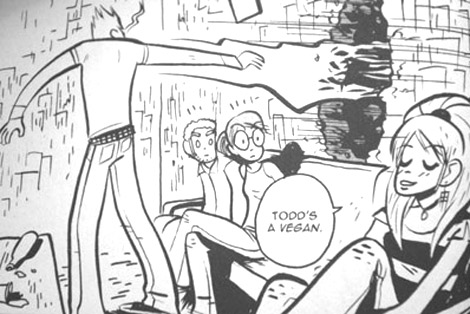
Jim here... Just a brief, fun post for the weekend... We just saw the movie Scott Pilgrim vs. the World a few days ago. ?It's a great movie, for many reasons. But, vegans will get a real kick out of one scene involving a character named Todd Ingram, who has super powers. ?Why? ?... Because he's a vegan! ?We won't spoil the scene, though. But, if you're a vegan, or know a lot of vegans, you should get a pretty good laugh from this! I think they nearly had to throw Wendi and me out of the theater, as we were laughing so hard (especially Wendi). ?Enjoy. :-)

Yesterday's post was a little "heavy," don't you think In it, we shared a bit of the stress we were experiencing related to our pending move. There was just so much data to pore through (and yes, we're still feeling that stress)!?
At times like these, it's often good to step back, breathe, and make sure you're not ...well, freaking out -- which makes today's "Take the Time Tuesday" installment absolutely fitting, for we would like you to meet a raw foodie who goes to great lengths to ensure that your "Vitamin L12" levels stay well into the superhero range. Without further adieu, then...
This isn't one of our normal blog posts. It's more of a journal entry, than anything else.
You see, I'm a bit sad today. The Raw Spirit Festival in Santa Barbara, CA, started today and I'm not there. We've been working really hard on many raw food projects, trying to sell our home, etc. So, spending the time and money to travel to the other side of the country for a weekend event just didn't seem like a good idea.I don't think we made the wrong decision, but I do admit I was hoping that somehow the Universe would conspire in some magical way to arrange for me to attend the festival this weekend.
For those who have never been to a Raw Spirit Festival, you might wish that you could attend something so totally awesome---to be surrounded by raw foodies you've met online, to attend the various speeches and events at the festival, etc.---but you probably aren't feeling completely sad that you aren't there. To have attended a Raw Spirit Festival, had your entire life altered by the experience, and then to not attend the next one is almost heartbreakingly sad.
Sometimes you meet someone and you just know they have tapped into something special, something most of us search for but never quite find. That was the case when I met this lovely woman I'd like the rest of you to meet. There's a centered peace about her, down deep in her core, and yet she's overflowing with an energy that I've never seen matched by anyone else. She's delightfully insightful, intelligent, and playful all at the same time. ?
Take the Time to Meet
I've been back from the Raw Spirit Festival for about five days, now. The first few days I couldn't stop crying. I have a lot to share with all of you, maybe more than you'll want me to share. While away some pretty amazing healing took place. I found myself lifted out of the past and delivered to the future, in a way. I am here, whole, and aligned with who I am on all levels.
Pure Jeevan means Pure Life (or Total Life). Raw food is only part of my life, part of who I am, part of my journey. So, I'll be openly sharing who I am here in this blog; raw food isn't going to be the main focus---it's just part of my story and part of what I want to share.
Until I can sit down to begin sharing everything that transpired while I was away and over this past five days, I'll share some pictures with all of you!
[Sorry, we lost the pic in a web update... will repost if we find it!]
Last night, Jim ate the first warm food he's had in over a year! I created a dinner that was placed in the dehydrator for about an hour before it was served. This dish is delicious at room temperature, also, but I thought it might be more special if I served it a bit warm. Jim thought it was a nice change to the colder temperatures of the smoothies he's been practically living on!
Here's the recipe, if you think you'd like to try it.

Hi everyone!? Sorry for the late post tonight. I had a busy day, and even met with a new realtor to help me sell The Luck House! (Wish us luck on that front -- but I have a super-great feeling that this new realtor is 10x more professional and knowledgeable than the previous one.)
 Today I thought I'd give you a peek into Wendi's rather fascinating Inbox. While she's away, she asked me to monitor her Pure Jeevan mail box and field as many of the questions as possible. It's been ... interesting! :-)? I never realized the volume of email that she receives! It's almost a full-time job to keep on top of it (which I haven't been able to do as well as I'd hoped -- although I now have it down to just a ?hundred or so unanswered ones, so that's progress!).

What fun do you have planned for yourself today, this weekend, or sometime in the near future? If the idea of having fun feels a bit foreign to you, then we sure are glad you found our blog. We'd love to encourage you to have some fun every day, but to especially have extra fun on the weekends (or whenever you have a couple of days off in a row).
What makes the weekends so special? For most people the weekends are a time when your schedule isn't dominated by weekly work commitments. It's a time when you can (no matter how busy your life is) probably arrange your days the way you'd like. So, why not arrange some time for fun? If you can manage it, try to arrange an entire weekend of fun for yourself!

One reason I keep going on and on lately about raw desserts and raw ice creams is best conveyed with an example. ?Here are the ingredients in Cool Whip, a commonly available whipped topping:
- water
- hydrogenated vegetable oil (coconut and palm kernel oils)
- high fructose corn syrup
- corn syrup
- skim milk
- light cream
- less than 2% of:
- sodium caseinate
- natural and artificial flavors
- xanthan and guar gums
- polysorbate 60
- sorbitan monostearate
- beta carotene (color)
Wow, I had a chemistry set in 5th grade that had a lot of things that sounded like some of those items. It's actually mind-boggling to envision the industrial processes necessary to produce everything on that list -- not that it's entirely possible to do so. After all, among the list of ingredients are "natural and artificial flavors." Ever wonder what, exactly, those are?
Read more: Natural and Artificial Flavors, and a Raw Whipped Cream Recipe


It's not much longer before I'll be serving all kinds of delicious foods to those attending the 3-Day Raw Food Spiritual Ashram Retreat! I've been working on the recipes and taking pictures to include with the bound materials going home with everyone attending the retreat.

So it's time to continue that discussion on the aforementioned fringe one percent -- those people who will not accept your conscious intention to pursue your own health via this path. Please keep in mind during this discussion that we're only discussing just that one percent, not people in general. So, this is, I hope, relatively rare.
To begin, I'd like to stress a few points: