Know Any Literary Animal Lovers?

Hi there PureJeevan readers! We wanted to let you know that Jim's new novel CHROO is available on Amazon. It's a crazy adventure involving a billionaire heiress, her Chihuahua BFF ("Chroo") and a host of human and animal characters. Find out more on Amazon! Here are some links:

I was grocery shopping in Giant Eagle with a friend the other day; I was just there to keep her company. When we left the Nature's Basket area (where they sell organics and more natural items), I felt a strange feeling. I hadn't realized it, but over the past two years I stopped shopping in the other areas of the store! I told her that by the time we hit the packaged shelves of the Nature's Basket area, I'd already be done shopping and my cart would be filled. We had a good giggle and went on shopping.
Anyway, that has since brought my attention to the shopping carts of those around me. We do about 5% of our shopping in Giant Eagle (last minute things that we've run out of, that don't merit a trip to our Food Co Op), so lately I've found myself in Giant Eagle looking into the carts of those around me. I'm not judging anyone, I'm just curious. On average, just about everyone has a small bunch of bananas in their cart. There are the occasional carts with something like a cantaloupe, a bag of apples, and once I saw a single tomato and a bag of lettuce. The rest of the carts have been filled with packaged foods. There is next to no living food in the carts.

We're going to be running the above banner for a few days as we bring you highlights of the raw food scene in the beautiful Florida Keys.

Yesterday's post was a little "heavy," don't you think In it, we shared a bit of the stress we were experiencing related to our pending move. There was just so much data to pore through (and yes, we're still feeling that stress)!?
At times like these, it's often good to step back, breathe, and make sure you're not ...well, freaking out -- which makes today's "Take the Time Tuesday" installment absolutely fitting, for we would like you to meet a raw foodie who goes to great lengths to ensure that your "Vitamin L12" levels stay well into the superhero range. Without further adieu, then...
"Should you eat when you're not hungry "
That was a question I asked myself a lot when I was first transitioning to the raw food diet. Just about everything I ever read said that people shouldn't eat if they aren't hungry. We need to listen to what our bodies are telling us in order to be as healthy as possible.
What if your body is telling you it's not hungry, however, while your instinct is telling you that you still need to eat That's what was happening to me in the beginning of my raw journey. My digestion was very slow and food would sit in my stomach for most of the day, especially if the food I ate was processed or heavy. It didn't matter how much I ate, either. My portions were always very small compared to those that my fit-looking friends were eating. I always wondered how I was the obese one when my meals were so minimal in comparison.
Read more: Inner Guidance: Should You Eat When You're Not Hungry?
Jim here... We know a lot of people who exist on a high-raw lifestyle, and many others who aspire to eat a 100% live food diet. I don't believe there is an exact threshold that makes one a "raw foodist." That term is more or less just a general description you might use about yourself or anyone. Aside from the labels, though... If you want to talk about recommended levels of raw intake for optimal health, quite a number of web sites and health books seem to recommend shooting for around 80% of one's intake to be raw, with a careful eye on the other 20%. We certainly agree with that as a good starting goal, adjusting upward or downward as you gain feedback from your body.
Of course, most of the people who do follow a high-raw diet are usually by definition highly health-conscious about any non-raw foods they eat. I've yet to meet, for example, a raw foodist who occasionally eats Burger King Double-Whoppers ?(although, I'm sure that seemingly odd combination must exist somewhere).

In our Mnemonics for the ?Clean 15? ? Or, ?Conventional? Produce That Tests Lowest for Residual Pesticides blog post last week, we put an asterisk next to "sweet corn" and took it off our list of foods to eat. Even though sweet corn tests relatively low for pesticides, Pure Jeevan still feels the vegetable isn't a safe choice for a healthy diet. There are primarily two reasons for our decision to completely remove corn from our diets. First, of all the vegetables that have undergone genetic modification (GM), GM corn is one that has been proven to cross-pollinate with non-GM corn. Second, since corn is so plentiful and easy to grow, it has been modified to become all sorts of flavors, sweeteners, fillers, etc., in food products and many individuals have developed sensitivities to it.
Read more: Is Corn Safe to Eat? No, and Neither is Most Papaya!
 Jim thought it was important for me to update everyone about my health, especially since so many of you have been sending emails, etc., and I haven't responded.
I do appreciate all the love and concern (thank you all so VERY much!), but it's painful for me to type for very long. This update is going to most likely bring about some more pain, but I don't want you to keep worrying about me and my health. So, I'll share what's been going on.
There's an antibiotic that will decrease the pain temporarily if you have Lyme disease (it won't help the pain if it's caused by anything else), and I was able to obtain some of it. So far, today is day five on it. And here's some great news: The pain started lessening on day three -- the aches completely gone, leaving only sharp pains when I move my joints in certain ways. I'll be on this antibiotic (and possibly some others for "co-infections" that sometimes come with Lyme, but I won't know until more blood tests are done and the Lyme specialist reviews the results).
I have a need for hot food in winter to feel warm.
We hear this comment a lot from those trying to lose weight. Some joke that they thought their excess body fat would be keeping them warm, but they're still feeling cold and needing hot food in the winter months.
In the past, we've talked about reasons what's going on in the body when hot foods are consumed. Understanding this will help you realize that hot foods are actually not very good for our bodies. When we consume very hot foods, that heat is then inside our bodies, next to vital organs, while the body needs to maintain a temperature around 98.6 degrees. When we have temperatures higher than that right next to our vital organs, it must quickly work to remove that excess heat. It's the removal of this excess heat that causes us to feel warm. It's our bodies trying to stay in a healthy state. We are actually putting our bodies under stress when we do this (the same holds true for eating overly cold foods, like frozen desserts and icy drinks).

In one daily newsletter that Wendi and I subscribe to, there was a discourse recently about being right -- but being right for the wrong reason. I've long been interested in that concept; it's fascinating, when you really think about it -- like getting credit on a test for an answer you guessed at, or knowing how to say something in another language but not knowing what it means. Along those lines, I'd like to share some personal opinion with you.
One of the common pro-raw arguments is that it's a calorie-restrictive diet and thus healthy because it limits our caloric intake (a regimen widely associated with extended lifespans in scientific literature).If you consider that a pound of greens or veggies has about 100 calories (generally speaking) and a pound of fruit has 300-400, imagine the incredible amounts of food you could ingest daily and still be considered calorie-restricted (as compared with the recommended number of calories for your build and lifestyle)!
Some of you have noticed that we've seemed a bit silent, or asleep, here at Pure Jeevan. We haven't abandoned our blog or our readers, though! For the next two weeks, it may continue to look like we are sleeping, but in reality we are doing anything but that! :-)
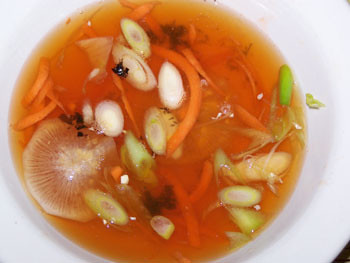
Here are some pictures of some recent meals we've been testing in our kitchen...

As you can see from yesterday's post, Pure Jeevan keeps extremely busy during the year. What's up for 2010? Let's just say... more amazing information, inspiration, education, motivation, and cutting-edge health features! This post will be considerably shorter than last year's counterpart. In January 2009, we ran a 3-part series on looking back and looking ahead. While that was super-productive from a planning perspective, a few important points come to mind as we ponder the same issues once again: