Know Any Literary Animal Lovers?

Hi there PureJeevan readers! We wanted to let you know that Jim's new novel CHROO is available on Amazon. It's a crazy adventure involving a billionaire heiress, her Chihuahua BFF ("Chroo") and a host of human and animal characters. Find out more on Amazon! Here are some links:
?
As we'll show over the course of this week, the Raw Spirit Festival is about much more than just delicious, nutritious raw food. In fact, there's usually so many fun things taking place simultaneously while you're there that it's easy to forget about the foods completely!
I'd been there an entire day before realizing that there was a raw food court on site. (Mostly, I'd been dining on fruit I'd brought along and had stored in a cooler in my tent!). Thankfully, I did eventually discover the food court, and it was really something special. To call it a "food court" is almost demeaning, as that phrase brings to mind bland "mall food" restaurants that serve up mostly fast food fare. At the RSF, you're treated with many delicious options, which can make choosing a place to dine rather difficult!

Here at Pure Jeevan we are preparing for our cross country tour to educate others about raw foods. This means we are paring down on a lot of things, donating a lot, selling some things, and pretty much not buying anything unless it's absolutely necessary. That's what we've been doing for almost two years now (we're waiting for the house to sell). Recently, however, I decided it was time to spend a little bit of money even if it wasn't absolutely necessary.
-
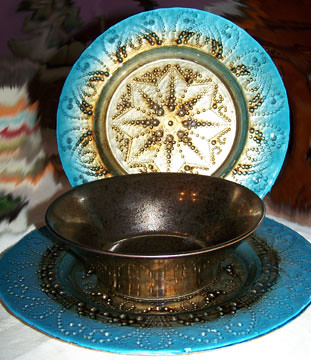
- Wendi's Dish Set
What did we buy? Dishes! Seems a bit strange to finally spend some money on something unnecessary and have it be dishes, right? Well, I had a few reasons for this purchase. The first is that when we are living in the RV, the space is going to be minimal. There won't be a lot of room for dishes, let alone much of anything else. Since there's not a lot of space to have dishes drying, we'll need to be washing, drying, and putting away immediately after use. That may not sound like a big deal, but when someone in the family decides to eat a few different things and leave the dirty dishes in the tiny RV sink, on the small counter, or somewhere else, it's going to really seem like a bigger mess than it is. So, to remedy this I thought it would be good for each of us to have our own dishes. That way we have a sense of responsibility for our own particular dishes--we know they are ours and we are responsible for taking care of them.

Hi everyone! ?We wanted to announce plans for a raw food picnic / potluck / meetup next Saturday, September 19th, at noon, in Berkeley Springs, WV at Berkeley Springs State Park (link to map), a wonderful natural healing destination about half-way between Pittsburgh and D.C. Wendi was just talking with Rawbin from the Capital Area (D.C.) raw food meetup and we all thought that a combo Pittsburgh / D.C. meetup might be fun. So, we all planned something right on the spot!
Berkeley Springs is a really nice (but small) public park in West Virginia about half-way between Pittsburgh and D.C.I traveled there a few weeks back with Melissa, Dave, Ella, and Bethany on the way to Raw Spririt East. We had a super time soaking in the spring water and checking out all of the cool alternative shops. (I did a write-up here on Pure Jeevan a few weeks ago and posted some video of the place).

It's been an interesting week for us here. We've looked at a handful of ways that people may either become obese, or sustain an obese body -- all largely for reasons outside of dietary intake. The three situations we looked at included maintaining weight as a defense mechanism (Tuesday), becoming obese through worrying about becoming obese (Wednesday), and obesity as basically a physical manifestation of a non-physical longing (Thursday).
Without a doubt, these are just three out of hundreds of possible non-physical contributors to poor health. The idea was merely to start a thread on these things, opening people's minds to possibilities that perhaps they'd never seriously considered.

Jim here... Okay, the title and graphic, above, may be a bit silly, as are a few of the remarks I made in the video, below. But, within this rather odd piece a few hopefully noble and economical ideas exist -- especially the ridiculously simple and obvious notion about reusing glass beverage bottles. I'm embarrassed to have lived on this planet for so long and not to have adopted this fun and environmentally friendly practice much sooner.
 We really do take things like glass containers for granted, when we probably shouldn't. Their ubiquity aside, it still takes a fair amount of energy and resources to make a single glass bottle. On the mass scale that they're made, they're obviously super cheap. But, if you had to start from scratch, it would take ages to make a single one, so we should at least appreciate them more and do all we can to make their continued existence as sustainable as possible.
Read more: If Keith Richards Is Still Alive, Then Can I Have a Little Tea?

Did you know that approximately 70% of your muscle, 80% of your blood is water, and 85% of your brain is made up of water? When we are born, we are nearly 90% water by weight, and as we age we lose more and more water (think of a grape slowly shriveling up into a dried raisin).
If you consume 100% fresh raw foods (with none that have been dried or dehydrated in any way), your body is receiving the cleanest, most pure water possible and you probably don't experience a lot of thirst. The less fresh foods an individual consumes, the more their needs for water increases.
On this page, we'd like to share some information about vegetable juicers. There are a number of different kinds, and we'll try to offer some background on many of the leading ones. We're affiliates for some, so if you're in the market for one of the ones we discuss, please follow the links we provide (or click the juicer pics) and you'll help support Pure Jeevan. But, either way, we certainly encourage you to consume fresh, delicious, nourishing veggie juices regularly!
The Jay Kordich Juicer -- The PowerGrind
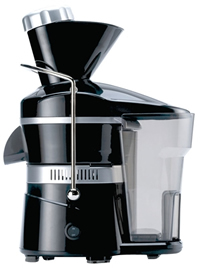 The PowerGrind Pro is a juicer put out by Jay Kordich, commonly known as the "father of juicing" by many in the raw food / living food world. In fact, our very first juicer was a "JuiceMan" model, purchased back in the early 1990s! But this is an entirely new machine, retooled from the ground up recently. At $289, it's a fairly high-end juicer (as compared with, say, department store models). However, it's certainly got the power and features to back up that level of investment. ?Head on over to the Jay Kordich web site for full details on the latest models.
The Hurom Slow Juicer
 A year or two ago, when we still lived in Pittsburgh, we hosted the Monarch's (Matt & Angela) during one of their speaking tours. I remember Angela firing up their juicer in the morning and I thought (or possibly even said), "Wow, your juicer is broken!" I swore that something was wrong because it didn't sound like anything I'd heard before. But they then told us about what was then the newest juicer on the market -- the Hurom Slow juicer. It's garnered a lot of positive testimonials over the past few years, from quite a lot of juicing enthusiasts. While many of the features are nice, we imagine the the most important potential benefit would be the slower speed, which theoretically means less oxidation, less processing, and thus healthier juice. If we were in the market today, I've no doubt we'd try one of these, too (even at $359)! These juicers are available through our good friends at Natural Zing!

I need fast & easy meal ideas (esp. breakfast & dinner) -- time is a luxury I don't have (taking 18 college credits, internship, PT job and I started a natural perfume business!). By the end of the day I am so exhausted that I'd rather not eat than go in the kitchen & try making somethin raw.
If you're dealing with exhaustion or fatigue, we'd like to direct you to a recent blog post discussing the subject. As for time being a luxury, we address that, as well, in the same post. You'll always hear the same thing from us about limited time in relation to your diet: Make the time! Your overall health is what's most important in life and it's imperative that you arrange your life so that you have plenty of time to not only prepare healthy meals, but to also eat them in peace without feeling rushed.
With that said, it's also important to realize that eating healthy doesn't need to take hours out of your life. There are plenty of raw food recipes that are not only quick and easy, but also packed with nutrition! We'll share, below, some links for some of our favorite recipes that are quick, easy, nutritious, and delicious! These recipes are located here on our blog.

Hi everyone. Did you miss me on Friday? Was your entire day absolutely hinging on evaluating the quality of the raw salad dressing recipe that you very rightly expected to see demonstrated right here? ... and then I posted nothing at all! Well, missing one day isn't so bad, really. I think it's the first one I've missed since Wendi stepped away from the blog temporarily. Anyone want to guess what happened? ... Yep, a nasty case of the flu took me down!?
O, my raw friends, I thought I was a goner Friday -- thought for sure I had th' deadly swine. But, being the resilient, nearly infallible raw foodie that I am, I totally kicked it's porcine rear end, and am now supercharged and ready to rock and roll once again here on Pure Jeevan's blog!
Read more: One for Lucy: Raw Thai Coconut Curry Salad Dressing!

Here's another brief video from our travels. Since time for editing is limited, I think I'll just run some more of the shorter vids this week and then get into the longer, more in-depth interviews next week. So, this is a short, fun conversation I had with Steve, who tends the raw juice and smoothie bar at Cousin's Incredible Vitality raw restaurant in Chicago. Here's the vid:
Read more: Pure Jeevan Interviews Steve from Cousins Raw Restaurant in Chicago
[Sorry, we lost the pic in a web update... will repost if we find it!]
Last night, Jim ate the first warm food he's had in over a year! I created a dinner that was placed in the dehydrator for about an hour before it was served. This dish is delicious at room temperature, also, but I thought it might be more special if I served it a bit warm. Jim thought it was a nice change to the colder temperatures of the smoothies he's been practically living on!
Here's the recipe, if you think you'd like to try it.