Know Any Literary Animal Lovers?

Hi there PureJeevan readers! We wanted to let you know that Jim's new novel CHROO is available on Amazon. It's a crazy adventure involving a billionaire heiress, her Chihuahua BFF ("Chroo") and a host of human and animal characters. Find out more on Amazon! Here are some links:

Today we welcome an up-and-coming raw chef, Sam, from DebbieDoesRaw for the first of Pure Jeevan's new Makin' It Monday "Guest Raw Chef" editions. Sam will demonstrate how to make a simple Peach Pudding, which she tells us is the invention of her very good friend Anthony from Rawmodel.com. We think Sam did a super job! Don't you ! Sam, you're welcome to guest-host on our blog any time you like.
Read more: Makin' It Monday "Guest Raw Chef" Edition Welcomes Sam!
Can you believe it's mid-October already ? Here in Pittsburgh, for those lucky few who may have fig trees, that means harvest time! Well, almost. Take a look at this video we made about figs!
As stated in the video, we did a previous installment on figs in our Know Your Food series (which will definitely be returning once we finally sell our home and become full-time raw food inspiration providers!). Please visit that link for nutrition and other information on figs.

We're going to be running the above banner for a few days as we bring you highlights of the raw food scene in the beautiful Florida Keys.
As promised, here's our interview with Leigh Crizoe, Rhio's partner and co-host of the Hooked on Raw Internet radio program. We think you'll love this interview, as it shows another perspective on raw foods and also gets into an interesting detox program that you may not have heard about. After 9/11, the New York City residents and workers close to ground zero breathed in highly toxic particulate matter for a long span of time. Rhio and Leigh live just blocks from the site, and both experienced respiratory troubles as a result -- especially Leigh, whose sweat began to stain his white t-shirts black! (Yep, you read that right: You'd actually sweat black! This happened to many ground zero workers, in fact.)
Who had the detox answer for them ?... Would you believe L. Ron Hubbard and Tom Cruise ? Apparently, detoxification was an area of high interest to Hubbard, the founder of scientology, who developed an intense regimen of saunas, vitamin supplements, and oils, all specifically for the purpose of ridding the body of toxins. According to Leigh, Tom Cruise personally funded and co-founded the New York program (which has proven highly successful!) after 9/11. (The official site for that detox program is here.)? Super-interesting stuff -- be sure to watch the video.
"Should you eat when you're not hungry "
That was a question I asked myself a lot when I was first transitioning to the raw food diet. Just about everything I ever read said that people shouldn't eat if they aren't hungry. We need to listen to what our bodies are telling us in order to be as healthy as possible.
What if your body is telling you it's not hungry, however, while your instinct is telling you that you still need to eat That's what was happening to me in the beginning of my raw journey. My digestion was very slow and food would sit in my stomach for most of the day, especially if the food I ate was processed or heavy. It didn't matter how much I ate, either. My portions were always very small compared to those that my fit-looking friends were eating. I always wondered how I was the obese one when my meals were so minimal in comparison.
Read more: Inner Guidance: Should You Eat When You're Not Hungry?
(Note: This is a closely-related piece to an earlier post ?entitled "Practice Is Your Key to Going Raw." I'll include a link to that article, below.* This one focuses more on recognizing your current level of progress.)
These days, I spend most of my free time cleaning up our fixer-upper home in Portland, so I haven't been going to the gym or regularly running as I had in the past. ?Hopefully, the house work is sufficient physical activity for me -- it sure does generate an appetite most days!
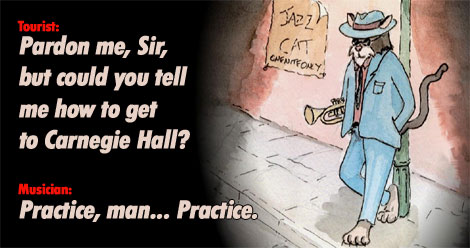
Jim here... Whenever I want to learn how to do something new, here's how I go about it:
>>> I practice. <<<

To help keep all of you inspired, we ve asked some
remarkable individuals to share their raw food stories with you. Enjoy!

Pure Jeevan is hitting the road? this weekend, heading to Chicago for some super-double-secret raw business stuff, returning late Monday. (Can't discuss it yet, but it's raw food related and ultra-cool. We'll get to it in due time, I promise.)?
Actually, it's going to be quite an interesting trip, as we have some very serious, very intense work to do in Chicago over the entire weekend, but we're not sure yet whether it'll be Wendi doing the work or me! It all depends on how Wendi feels -- and with Lyme, you just never know. So, one of us will be busy, the other largely free to explore the windy city with KDcaT and Th' Jooge.
Read more: Pure Jeevan Hitting Chicago This Weekend. Suggestions Anyone?
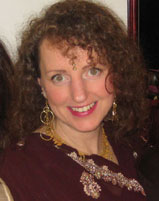 Jim thought it was important for me to update everyone about my health, especially since so many of you have been sending emails, etc., and I haven't responded.
I do appreciate all the love and concern (thank you all so VERY much!), but it's painful for me to type for very long. This update is going to most likely bring about some more pain, but I don't want you to keep worrying about me and my health. So, I'll share what's been going on.
There's an antibiotic that will decrease the pain temporarily if you have Lyme disease (it won't help the pain if it's caused by anything else), and I was able to obtain some of it. So far, today is day five on it. And here's some great news: The pain started lessening on day three -- the aches completely gone, leaving only sharp pains when I move my joints in certain ways. I'll be on this antibiotic (and possibly some others for "co-infections" that sometimes come with Lyme, but I won't know until more blood tests are done and the Lyme specialist reviews the results).
Jim here... A health-conscious friend of mine was feeling sick today. And, while I certainly do not advocate harping on the sick, I did have a very mild discussion with her when she phoned me for some advice. I asked, "Do you know what cognitive dissonance is "
"I'm not sure," she replied.