Know Any Literary Animal Lovers?

Hi there PureJeevan readers! We wanted to let you know that Jim's new novel CHROO is available on Amazon. It's a crazy adventure involving a billionaire heiress, her Chihuahua BFF ("Chroo") and a host of human and animal characters. Find out more on Amazon! Here are some links:

Announcing: Pure Jeevan's Halloween Raw Pot Luck - A Costume Party for All Ages!!
When:? October 31, 2009, 6:00 p.m. - ? ?
Read more: Pure Jeevan's Raw Halloween Bash -- You're Invited!
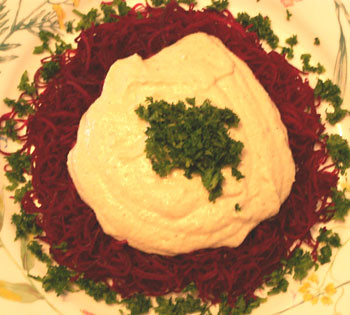
The mono meals ended and I did create that beet pasta with alfredo sauce that I was dreaming about. So, here's the recipe:
BEET PASTA
As you read this, calming violins open a familiar tune and that sweet mellifluous voice of Etta James soon enters your mind: "At laaaaaaaaassssst. My looooove has come along....." Great tune, right ! Well, it's appropriate here because, at LAST, here's the long-awaited Episode #9 of Know Your Food! That's right, friends, today we're going to explore the wondrous FIG in all of its sweet, soothing glory. One taste and happiness blossoms within you, washing over your entire being... We only wish that the following video was as professionally rendered as this paragraph of evocative prose... (but, we promise we'll get there one day).
In case you missed the actual nutrition info in that video (what little there was, LOL), here's the transcript:

We're into soft foods and treats these days, because Jim recently had a wisdom tooth extracted (KDcat insists he is less wise for having done so). We've been having a lot of fruit smoothies! I made a big mistake and created a smoothie with a grapefruit for the juicy part (I normally only use oranges). I don't care for grapefruit, because the bitter part just isn't appealing to me. However, I thought for sure that bananas and frozen berries would override the bitter taste of the grapefruit. It didn't, so I added some agave to the mixture and blended it again. Nope--still bitter. So, I asked Jim to taste it (he LOVES grapefruit) and he thought it was fantastic. He consumed the entire pitcher of the bitter concoction.
Okay, we promise that, once the "Know Your Food" series normalizes (hopefully by next week), we'll be posting daily 3- to 4-minute segments, not these gargantuan bandwidth- and free-time-hogs! But, it's a decent 8 minutes of solid entertainment (kind of/sort of). So, hope you enjoy. We call this "Episode 1 (sort of)." You'll see why. Includes a few bonus minutes of discussion on goals & synchronicity.
As you saw, we didn't air the entire APPLE show. So, a few notes are in order:
Today, for Makin' It Monday, Jim has taken you through the steps of making a vegetable wrap. He came home for lunch, pulled the veggies out of the fridge, and the filming began. He quickly shows how just about anyone can prepare fresh, raw, delicious food in less than fifteen minutes. His goal was to get it done in under ten minutes, but it actually took about fourteen. Still, fourteen minutes to prepare amazingly tasty, delicious, and nutritious food is AWESOME!
Recently I've been to three potlucks in the span of four days. They've all been wonderful for different reasons -- one was a birthday party for a lovely young woman, Bethany, another was part of a women's circle that my friend, Melissa, invited me to attend, and the other was at my home as a meetup when Kevin and Annmarie Gianni were here visiting. Lots of fun, connecting with people, and raw foods to eat.
Sounds perfect, right? Well, something's been happening with me and raw foods over the past year. It became even more evident after eating at three different potlucks over four days. I've noticed more and more that when I don't eat something that I've created, I many times have reactions to the foods I've eaten. The reactions have ranged from flushed facial skin, slight headaches, hives, full-blown headaches, upset stomach, water retention, achy joints, etc. All signs of being sensitive to something I'm eating, right? I've narrowed it down to a few things, but it doesn't seem to be an exact science to knowing what's going to cause the reaction.
At home I know that I feel better if I don't consume garlic even though I love the taste and smell of it. When I eat too much of it I experience headaches and sometimes flushed cheeks. I gave up raw vinegar a long time ago because it makes my joints ache. Recently I noticed that whenever I eat Nama Shoyu I get a headache, flushed cheeks, and sometimes some hives. So, at home I can control my reactions to foods -- I simply avoid eating the things that sometimes trigger problems for me. I feel great most of the time because I eat more simply and my body doesn't experience any problems.
Read more: Something Has Been Happening With Me and Raw Foods
***** DISCLAIMER: As with all of our posts here at Pure Jeevan, and particularly those tagged with a new term, "Nadi Balance, please refer to the disclaimer that runs at the bottom of all Pure Jeevan pages. Wendi and Jim are health researchers, educators, and extreme self-experimenters, not doctors. ******

Yesterday, we talked about live blood being a fantastic indication of overall health and well-being.Wendi's initial live blood review didn't show the extent of the Lyme disease. But, it did show an indication that something was going on (while Jim's blood showed overall health).
Read more: Nadi Balance: Exploring Fats and What Finally Healed Wendi

When you're young and learning the letters of the alphabet, anything that starts with the same letter as your name becomes really special. Well, ever since I was a child and saw a Winnebago RV with the giant "W" on the side, I've been enchanted with the idea of one day owning one and traveling the world (at that age, I didn't realize I'd have to cross oceans to see everything).
If you've been following us for a while, you'll know that I was bringing that vision to life. It took years of convincing, but Jim was finally ready for such an adventure and together we began making plans. For more than two years we've been preparing to tour the country, while teaching about raw foods along the way. Our lives changed so dramatically when we found a way to heal our bodies (and more), a way that can also help others, and we just couldn't sit still. We feel called to spread the word about the raw food diet so others can at least hear that there's another way, that there's something different to try in their quest for health. I knew that crossing the country in an RV, planting the seeds about a raw food diet along the way, would be an efficient way of spreading the word.

As this is a holistic web site, it's important that we take time every so often to feature pieces on other aspects of human health besides diet. So, today's subject is unrelated to raw foods, but is directly related to your health. (Don't worry: We'll get back to raw foods on Monday!)
Today I want to share a super-valuable lesson I learned when I was just 21 years old. Back then, Wendi worked within the advertising department of a large newspaper. She helped me meet the paper's photography editor who, in turn, approved an internship for me during my senior year of college. So, several days per week for one semester, I hung out with professional newspaper photographers. It was a lot of fun -- and with real darkrooms, too (as this was way before the age of digital cameras).
EDIT: This is NOT an advertisement.
Jim just thought it was interesting how he could easily substitute "raw food" in place of the ROM machine and have their advertisement make sense for the raw food movement.We will NOT be purchasing a machine like this. ;-)
?
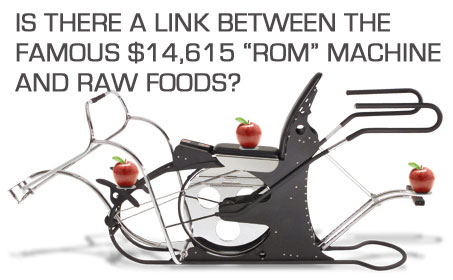
Read more: Interesting Link Between ROM Machines and Raw Foods?