Know Any Literary Animal Lovers?

Hi there PureJeevan readers! We wanted to let you know that Jim's new novel CHROO is available on Amazon. It's a crazy adventure involving a billionaire heiress, her Chihuahua BFF ("Chroo") and a host of human and animal characters. Find out more on Amazon! Here are some links:

When I first decided to try a raw food diet again (I had sampled it for about three months a few years before going completely raw), I wanted to do it in a way to prove that it either does or doesn t work. The best way to do that, I figured, was through consistent blood tests. So, that s what I did. I have continued to document my path to health with regular blood tests. Many of you know that the results have been remarkable. My dramatic shift in weight is the most obvious to others, but there were equally impressive changes going on inside my body, as well.
It has been about a year since my last blood work was done, so I knew I should schedule an appointment to get the testing done soon (since I want to keep the tests somewhat yearly). I tend to always put the testing off, however. As much as I m curious about the results, the truth is that I m terrified of needles. Over the past few months, I was continuing to put this yearly testing off, but something has spurred me to get it done sooner than later.
Read more: Raw Food and Measurable Health: Does Wendi Have Lyme Disease?

Did you know that, among the handful of programs I continually have running, there is always a dictionary program active on my laptop Oh, sure, there are tons of great web sites out there for looking up words -- and I do use those regularly. But, I just like my handy-dandy dictionary program. It's instant (no waiting for pages to load, etc.), it's ad-free, and it and has a great? -- no, scratch that, a tantalizing! -- thesaurus as well.
Anyway, here's what my trusty friend, the American Heritage Dictionary, has to say about the phrase "will power":
Jim here... Today Wendi is busy preparing for a multi-day activity that I'm sure she'll be writing about later this week. So, I thought I'd field a question we received recently (one directed specifically to me). We do receive a good deal of questions at our Raw Food Diet Question In-box (at Questions [at] PureJeevan.com), so feel free to send any in that you may have, and we'll definitely get to them all here in time. In any case, one reader writes:
As drawn as I am to a raw diet, being mostly cooked vegan right now, I can't help but come up against this each time: Since produce is, after all, mostly water, what did you eat while transitioning that didn't lead to shoving in lots of bread, potatoes, etc. Do you just eat lots and lots of, say, oranges, at one go? This has always been my raw downfall. I'm sure the answer is very simple.
Wow, this is a great question, and one with many possible answers! To begin, let's recognize that this isn't a question from a "SAD diet" eater. ?Being a vegan, alone, takes significant learning and (often) self-discipline to accomplish successfully. It's also, in my view, an excellent dietary and lifestyle choice for many people, regardless of whether they ever decide to try a raw foods diet. So, this question is rather advanced.

Here's some coconutty video footage from our Florida Keys excursion. First up is some footage of Randesh, from www.TheGuana.com, who obtains fresh coconuts for Charlie Wilson's Key West restaurant, Help Yourself (see yesterday's blog post).Notice that Randesh uses a proper piece of equipment -- a large machete (or cutlass) -- which makes short, easy work of opening these precious gifts of nature! In the video footage following that, you'll see how comically difficult it is to open a young coconut when you lack the proper equipment. We actually went out looking for a machete, but could only find a large chef's knife at a local K-Mart. Yep, they were sold out of machetes! (Ironically, the chef's knife -- the heaviest one the store had -- cost about $17, while plain old machetes run just $10 or so at most hardware stores. Next time we'll keep looking...)
I'd like to talk with you about diet and experimenting. I've been learning about natural healing and foods/health since I was a very young woman. Somewhere along the line I knew that what I was eating was either making me feel better, or worse, and that food was related to health (it was more than just to fuel the body). It was with this knowledge that I stepped into the realm of natural healing and stumbled around for most of my life.I've learned about vegetarianism, herbs, the negative effects of dairy on the body, veganism, essential oils, Ayurveda, harmful chemicals in and around our foods, and so very much more. I don't claim to be an expert on any of these topics, they are just part of my overall bank of knowledge and experiences from which I pull to live as healthy as possible.
In some recent Summertime Raw posts, we've focused on preparing delicious, nutritious raw foods *while* on the go. Today, however, we're doing an outing with all of the prep work done at home -- so no need to pack knives and cutting boards! We're also focusing in on a few seasonal ingredients. You'll see some really tasty uses for mint, and we'll also take a look at some wonderful edible flowers. Here's the video:
Read more: Summertime Raw: (Video) Undeniably Magical Sparkling Wonderment!

 Yesterday was a ton of fun, wasn't it? Sam loves all of the comments, so if you haven't viewed her video, please do -- and let her know how much you enjoyed it!? For today, we just wanted to announce the addition of a permanent new button along the right sidebar of our blog. As you can see, it links to this post from a few weeks back when we first announced a call for guest raw chefs. There, you'll find the details on hosting a segment of Makin' It Monday, just like Sam did.
By the way, just last week, we passed a noteworthy milestone that we didn't mention -- our 500th blog post here at Pure Jeevan. That's a lot of raw foods coverage, right ! Well, we're really still getting started when it comes to the level of information and inspiration we're planning for Pure Jeevan -- so it's great to add new features like this now, as we're able to. Of course, once our home sells and we're finally able to move on to the next phase of our lives, we envision Pure Jeevan exploding with more content than ever before. What fun it'll be to be able to devote ourselves full-time to spreading the word about raw foods!
Original Comments
Below, we have included the original comments from this blog post. Additional comments may be made via Facebook, below.
Read more: Be Part of Pure Jeevan's Makin' It Monday Video Series!
In some wonderfully literary sense, there must be some kind of unique metaphor that could be constructed around the process by which cabbage turns to kimchi. Personal growth is not always easy, as any success technologist will surely tell you; ?there's a lot of doubt and oozing and off-gassing involved -- and yet, the final product is surprisingly pleasing to the palate.
Yes, it's time for us to update you on our first-ever kimchi experiment. If you want the short version:? I believe we have been successful! For those of you with a few more minutes, I'll share some of the lurid details. Highlights of our experiment included:
(Note: This is a closely-related piece to an earlier post ?entitled "Practice Is Your Key to Going Raw." I'll include a link to that article, below.* This one focuses more on recognizing your current level of progress.)
These days, I spend most of my free time cleaning up our fixer-upper home in Portland, so I haven't been going to the gym or regularly running as I had in the past. ?Hopefully, the house work is sufficient physical activity for me -- it sure does generate an appetite most days!
This recipe is an adaptation of one from "Rawvolution", by Matt Amsden. As of this point in time, "Rawvolution" is my favorite recipe book. Most of the recipes are high in sodium and fat, but very satisfying for those who are used to eating cooked foods.
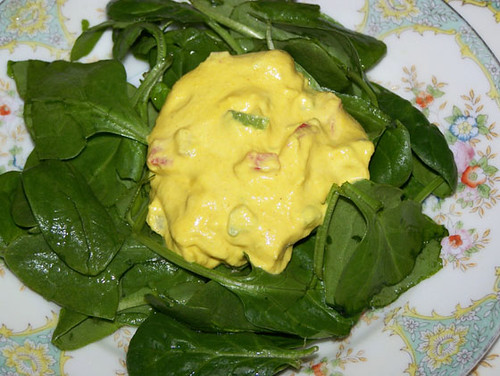
Egg-less Egg Salad

It's time for a little Phun Phriday Philosophy. (I hope you don't mind a little levity as we end this glorious week ) It just occurred to me that philosophers and self-development gurus commonly admonish against "attachments." Isn't that true ?We're attached to our egos, our possessions, our relationships. All attachments are bad, it is said. I believe one of the primary tenets (Noble Truths) of Buddhism centers on this very thing -- that our attachments cause suffering.
 Well, all of that may be food for thought. But, when it comes to food for your body, I'm here to tell you that attachments are GOOD -- especially, when we're talking about the shredder attachment for your food processor!? Oh, don't lie to me, fellow raw foodie (or raw aspirant, as the case may be): You know you've neglected this wonderful tool, haven't you? -- relegated it to some unimportant place in the back of a kitchen drawer somewhere, right ! Well, it's time to rediscover the shredder blade! Your mission, should you choose to accept it, is to reconnect with this delightful food processor attachment.
Read more: Are You 'Shred Up' With Your Food? If Not, Maybe You *Should* Be!