Know Any Literary Animal Lovers?

Hi there PureJeevan readers! We wanted to let you know that Jim's new novel CHROO is available on Amazon. It's a crazy adventure involving a billionaire heiress, her Chihuahua BFF ("Chroo") and a host of human and animal characters. Find out more on Amazon! Here are some links:

End of day 4:
Yesterday I decided to go ahead and consume what my body was telling me it wanted: cooked, fermented rice and lentil pancakes. Well, the restaurant nearby that makes the Uthappam doesn't serve them until 5pm and it was lunch time. So, I ordered the simpler, steamed, fermented rice and lentil patties called Idli.

We began this series with one possible psychological explanation of obesity, moved on to a possible philosophical explanation, and will now cover one that could be both of those, or could find classification within the emotional and/or spiritual realms. ?Wendi has often told me of hearing Dr. Gabriel Cousens speak in Sedona, Arizona, a few years ago. One remark in particular stuck with her. This may be a slight paraphrase, but Dr. Cousens said:
"There's never enough food to feed a hungry soul."
As we all know, physical hunger happens when our bodies need food -- when our stomachs are literally empty and aching for fuel to sustain our life. But, what about non-physical types of "emptiness"? Surely, we experience a kind of hunger in these cases as well.

It's been an interesting week for us here. We've looked at a handful of ways that people may either become obese, or sustain an obese body -- all largely for reasons outside of dietary intake. The three situations we looked at included maintaining weight as a defense mechanism (Tuesday), becoming obese through worrying about becoming obese (Wednesday), and obesity as basically a physical manifestation of a non-physical longing (Thursday).
Without a doubt, these are just three out of hundreds of possible non-physical contributors to poor health. The idea was merely to start a thread on these things, opening people's minds to possibilities that perhaps they'd never seriously considered.


Rita Romano, author of the widely available book Dining in the Raw and executive chef for many years at the Hippocrates Health Institute, is a true pioneer of the raw movement. We were thrilled to have the opportunity to visit with her and her two lovely Boston Terriers, Angel and Oreo. Here's PART TWO of our talk with her:

We at Pure Jeevan enjoy eating salads. Each of us has our own way of dressing our individual salads, but we all thoroughly enjoy very large bowls of them at least once a day.In the past, salads were those "diet" meals that I'd consume when I was trying to lose weight. I'd sit at the table staring at my small plate of greens, feeling like I was missing out on the "great" food everyone around me was eating. I'd feel hungry after my meal and extremely unsatisfied.

And you thought Apple Cider Vinegar was tough to pin down ? Ever come across the whole fluoride controversy
A Google search on "fluoride" returns 6,300,000 results.A Google search on "fluoride toothpaste" returns 246,000 results.
Before we run this blog entry, let me first announce one awesome thing:? Wendi and Kdcat are back home now!!? Yep, the trip is now officially over, and was a HUGE success. Not only did our fearless raw travelers identify Pure Jeevan's soon-to-be new home town -- Portland, Oregon! -- but Wendi and KDcat also met and made friends with hundreds of people from around the country. I'm sure Wendi will be back here on the blog with overall reflections and so forth soon. However, the trip generated so much content that it's going to take a while to catch up!? So, let's pick up with the travel narrative where we last left off. As you may recall, the girls were leaving San Luis Obispo and heading into sunny Los Angeles! Let's see what Wendi had to say, again with her travelogue:
 Wow, it's finally looking like CA with all the palm trees! After hitting and dealing with some major traffic of a large city, we arrived to the warmest welcome at the home of Debbie Young (of DebbieDoesRaw) -- a decorative greeting waiting on the door, gift bags handed to us as we walked inside, loving hugs and smiles, and the most amazing raw meal ever (samosas!, chai, pineapple lassi, mango chutney, tamarind chutney, biscotti cookies), and a snack basket waiting in our private apartment! At this stop, we were totally spoiled by Debbie and her beautiful family!
This is one of the stops I was really looking forward to, because Debbie and I have been online friends for a long time. We were able to spend a short amount of time together at the Raw Spirit Festival in 2008, and I loved her and wanted to spend more time with her and meet her lovely family in person (including their adorable dog, Malcolm).
Read more: 2010 Trip Coverage Continues: Los Angeles, California!!!

I want to admit something to all of you: Sometimes I still cry because of how people treated me when I was obese. Because I stuffed all of my "negative" emotions deep inside my entire life, it's going to take some time to fully release them. I'm working on it, however, and making tremendous progress with healing myself on all levels. I'm not telling you these things so you'll feel sorry for me, however. I'm telling you because I am thankful for all the pain I endured. It shaped me (in more ways than just my physical appearance) into the person I am today.
Even though it sounds strange, and somehow wrong to feel this way, I'm thankful that I was obese. I'm thankful for all of the experiences during my life, even the extremely painful, traumatic ones. Maybe if I was a different kind of person I would wish that those things didn't happen to me. However, I am using those experiences in positive ways. They've helped me understand people even better, and to understand myself on a deeper level, as well. When people reach out to me it's not only because I'm an approachable person, it's because they sense that I understand them--and they're right. I DO understand them. I understand you. My experiences, coupled with my gift of empathy, help me relate to you in a way that maybe not everyone else is able to do.

"I sent out over 100 emails, now, and have been corresponding with the chair of the almond board. He s an ass."~Wendi, writing a few years ago in her "Almond Frustration" blog post.
Jim here again... Wow, that's an excerpt from a very fired-up Wendi, writing a few years ago about her frustration over the USDA's absolutely insane regulation that nearly all almonds sold in the United States must be treated with chemicals or heat prior to sale. I'm sure you know the story by now, so I won't rehash it here. (In case you do not, you can read about it in our original post, Wendi's Almond Frustration post (which even recounts a disturbing, related dream she had about this issue), or our last update post. It's an issue we've been following for years here.)
Read more: One Step Closer to the Return of Truly Raw Almonds!
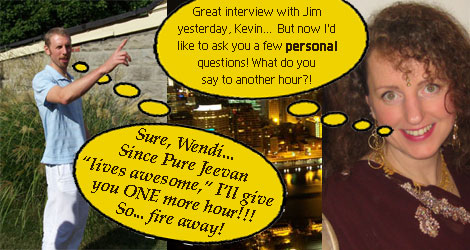
So, did you like Part One yesterday ? Pretty great, right ? Well, today we present Part Two, in which Wendi takes the interview into a more up-close and personal place. In this audio, Kevin shares details about:
-
the first interview he ever conducted
-
what he wanted to be when he grew up
-
what his family thinks of his raw lifestyle
-
his tattoo, Joseph Campbell, and thoughts on life and death
-
spirituality, religion, and guilt
-
the book that opened his mind to a deeper connection
-
running and spirituality
-
his typical day / routine
-
his business expanding
-
what "systems" are and how he uses them
-
the shocking truth about his teen years
-
recent personal development programs he's listening to
-
"taking 1%, applying it, and moving on"
-
mentors and influences
-
the books that shaped his life
-
making shifts in friendships
-
his thoughts on "The Secret"
-
whether he thinks he can do more push-ups than Gabriel Cousens
-
why there was a donkey at his wedding
-
his biggest wish (it's a beautiful one!)
So, what are you waiting for ? Listen NOW!!
Read more: Part *2* of a 3-Part Series Profiling the Multi-Talented Kevin Gianni!


Q. Do you know of any nutritional protocol that would be beneficial for reducing or *gasp* even healing fibromyalgia using a high raw diet regimen
Do you feel that something like live blood testing, or mineral level testing would be beneficial? Wendy, after following your long ordeal with Lyme disease **Gentle Hugs to you** I believe you might be able to understand the pain, fatigue and depression that is involved while dealing with a chronic illness. ?I am looking forward to hearing more about your healing journey!
Sending love,? C.