Know Any Literary Animal Lovers?

Hi there PureJeevan readers! We wanted to let you know that Jim's new novel CHROO is available on Amazon. It's a crazy adventure involving a billionaire heiress, her Chihuahua BFF ("Chroo") and a host of human and animal characters. Find out more on Amazon! Here are some links:
Jim here... Wow, we haven't posted in a few days. That calls for some action! Hmmm... how about taking a look at some delicious mini pizzas Wendi whipped up the other day:
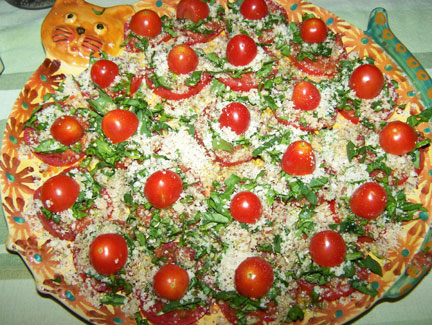
We went absolutely nuts for these little "pizzas." They were both tasty and fun. If memory serves, I believe she made them by taking slices of firm roma tomatoes, spooning on some improvised pesto sauce that she whipped up, sprinkling on some chopped basil leaves, sprinkling on some "cheese" that she made with ground Brazil nuts, garlic, and salt, and then topping each "pizza slice" off with a half cherry tomato. No recipes necessary here; just take a look at the picture & go try it!

Many people have asked us about the Raw Spirit Festival (RSF): What is it? When is it? Where is it? Will we be going ? So, we wanted to take a moment to answer those questions.
-
What Is It ? Well, as any long-time reader of this blog is likely aware, RSF is a very special event! Not only does it have its own web site, which we encourage you ti visit in order to learn more, but we've also devoted an entire category of the All Raw Directory to "Raw Spirit Festival Memories," a place where people can post links to blog entries, photo sets, and videos from various RSF events.
?

On March 1st we started a Juice-a-Day Jamboree, to challenge ourselves (and our readers) to include more fresh juice into our diets. We knew we weren't ready for an all-out juice feast, but a juice a day seemed like something we could commit to in our daily lives. So, the Juice-a-Day Jamboree was born. We've been posting periodic updates on our original post about the Jamboree, but figured we'd post periodic juice updates in the main part of our blog, as well, to encourage others to add some more fresh juice to your diets, as well.
We've missed one day of juice since we started the Jamboree. Our original goal was to have our juice first thing in the morning, but we weren't always successful with that. So, we told ourselves that any time of the day is fine, but if we can start the day with a juice we'd prefer it that way. The changes we've been feeling are more pronounced when we begin the day with fresh juice, rather than when we have our juice later in the day.
Jim here... I'd like to mainly talk about organics today, but thought I'd wrap that subject into a longer, rather quirky piece on ranking produce on some sort of a scale that would indicate how awesome (or awful) it is. See what you think...
Have you ever thought of arranging produce into a sort of "heirarchy of quality"? Well, I'm not going to attempt to do that here, but I would like to discuss the concept for a moment in order to at least explain what I'm getting at. While I've not yet attempted to do this exercise, I nonetheless occasionally envision a large chart or something that conveys my feelings about how I personally rank the quality of fruits and vegetables I put into my body. This all probably sounds vague, so let me share some examples.
Read more: Pure Jeevan's "Produce Buying Tips" Series, #2: Buying Organics

Pure Jeevan is hitting the road? this weekend, heading to Chicago for some super-double-secret raw business stuff, returning late Monday. (Can't discuss it yet, but it's raw food related and ultra-cool. We'll get to it in due time, I promise.)?
Actually, it's going to be quite an interesting trip, as we have some very serious, very intense work to do in Chicago over the entire weekend, but we're not sure yet whether it'll be Wendi doing the work or me! It all depends on how Wendi feels -- and with Lyme, you just never know. So, one of us will be busy, the other largely free to explore the windy city with KDcaT and Th' Jooge.
Read more: Pure Jeevan Hitting Chicago This Weekend. Suggestions Anyone?

I've already posted the recipe for this, but I wanted to talk about the orange pudding a bit. Since going raw, I've become a mostly intuitive eater. Whatever I feel like eating is what I eat. This usually means I am eating the same food for an extended period of time until I feel drawn to something different. Lately it has been the orange pudding.
I've been starting my mornings with a large bowl of it. If Jim is making lunch then I'll eat the salad or nut dip that he makes, otherwise it's orange pudding again. Then, if I didn't eat a salad during the day I usually have a salad for dinner and...a dessert of--you guessed it!--more orange pudding.

To keep all of you inspired while we are away, we've asked some
remarkable individuals to share their raw food stories with you. Enjoy!

Since Pure Jeevan specializes in raw food weight loss, we receive a lot of questions about what is required in order to lose excess weight. Many individuals want to know if they need to go on a 100% raw food diet in order to release excess weight.
The answer is, "No, you do not need to switch to a 100% raw food diet in order to lose weight." If you're asking if a 100% raw food diet works better for losing weight than slowly transitioning and increasing your raw food intake, the answer is still, "No."

When it comes to healthy eating, most of us know what is and isn't healthy for our bodies. Sure, we've been a bit confused by what the media and our government tells us, but overall I think we can all confidently say we know that consuming fresh fruits and vegetables is going to be a healthier choice than eating a McDonald's hamburger and fries. Right
But, what do we do when we're dealing with stress in our lives? What if when we're stressed we instantly head to McDonald's to eat the burger and fries we know aren't healthy for us? Or what if we consume large quantities of cakes, candies, or ice cream when we're overcome with stress

We're here to inspire you...that's our overall focus here at Pure Jeevan. So, when we ask you what you'd like us to do more of, less of, or to consider doing here on the blog ... we take your responses to heart. Of course, it's impossible to please every single person since we all have different personalities and needs. However, we'll always do our best to create a balance in order to inspire as many individuals as possible.
Below are suggestions for what some of you'd like to see happening here on the blog, along with some responses from us. If you have more suggestions, please send them our way anytime. We read everything that comes in and will always give your suggestions serious consideration.
All this week we're continuing to feature a variety of answers to the question "Are Raw Foodists Crazy " from various friends of Pure Jeevan. If you're just now tuning in, please read the back story and introduction to this, as posted on Monday.But, for now, let's continue with posting the rest of the excellent responses sent in! Enjoy!! :-)