Know Any Literary Animal Lovers?

Hi there PureJeevan readers! We wanted to let you know that Jim's new novel CHROO is available on Amazon. It's a crazy adventure involving a billionaire heiress, her Chihuahua BFF ("Chroo") and a host of human and animal characters. Find out more on Amazon! Here are some links:

As some of you already know, along with regaining my physical health I've also been working on every other aspect of my overall health and being. I don't just want a healthy body---I want the whole package (vibrancy and bliss inside and out, in every way possible).
One area of my mental health that has been slow to heal is my self confidence. I continue to work on it in many ways and have made some tremendous progress over the past year, or so. I feel worthy of so much more than I ever did before.Many people never doubt their self worth---they have a good sense of who they are and assume that others see them as they are, as well.
Read more: Thankful Thursday: We Like It Raw and Dhrumil Purohit
Ketchup
1 cup sun dried tomatoes, soaked for one hour
3 small fresh tomatoes

It's a beautiful day here. The sun is actually shining enough through the clouds to soak up some of its lovely rays. It feels so good. What a great way to start the weekend! We have no set plans, other than a trip to the local food co-op and a visit from the bunny. If the weather continues to be this nice, maybe we'll take the puppy over to the park and spend the afternoon enjoying the sights, smells, and sounds of Spring.

Today we bring you the last of our personal video interviews conducted while at the Raw Spirit Festival (RSF East 2009). I'll have one other highlight reel to run next week, just to round out this series by showing some of the additional ambience there.
So, we've finally come to the "infamous Viktoras video"! I smiled as I wrote that because it was quite the topic of discussion around our camp site. You see, one of my fellow campers, BH, was with me as we interviewed Viktoras (she filmed the interview, in fact) -- and, well... let's just say he strayed a bit from the expected raw food subject matter. I was worried that poor BH would be scarred for life after witnessing the discussion, but she did seem to get a good laugh out of it, and I suppose she's fully old enough to attend an R-rated movie.

Here's a video demonstrating a technique for making super-fast, vibrantly beautiful, tasty salads! If you frequently find yourself in a rush, but also want a healthy meal, definitely check out this mandoline technique. (Further commentary below, after the video...)
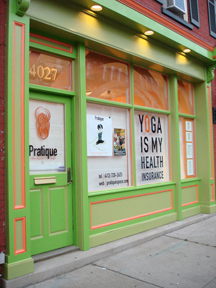 This morning as I was driving from the beautiful Carnegie Mellon University campus to a business meeting outside the city, I had to take a detour at one of Pittsburgh's many bridges. It was a little frustrating because I had hoped to arrive at my destination early enough to grab a green tea at a coffee shop. But, these little delays happen. I'm glad this one did, though, because I soon passed a small yoga studio (called Pratique) where an interesting window decal hangs. It reads: "Yoga is my health insurance."
Many kudos to the clever people at Pratique who apparently crafted this catchy and spot-on message. While this is a raw foods site, not a yoga site, the message is equally apropos here. It essentially means, in my view, that we all have the opportunity to profoundly affect our own health and well being.
In our family, we're currently facing the realistic prospect of taking a literal approach to this concept, dropping formal health coverage! Quite literally, we feel that maintaining a health plan is (almost) a complete waste of money. I'm not posting this to start a debate as to whether those who follow a healthy diet should or should not buy into a plan. (I know all of the related arguments already: Yeah, but what if you cut your arm and need stitches Save that for Facebook or, at least, some other time.) I'm more concerned with reiterating one of our key messages here at Pure Jeevan -- our unwavering ?conviction that physical health and diet are tightly connected. Wendi knows this, I know this, our child knows this, YOU know this... But why doesn't everyone acknowledge it?

Driving to work today, we noticed that McDonald's has launched its latest product aimed at the health-conscious demographic. In case you haven't heard, you can now purchase fruit smoothies at Mickey D's! Sounds like real progress, right? Well, let's take a closer look and see if they're really as healthy as they sound.
McDonald's is not exactly known as a healthfood destination. After all, a typical lunch at the Golden Arches these days might well include something like an Angus Bacon & Cheese, Large Fries, and a Large Coke. ?Together, that's 1,600 calories, 64 grams of fat, and 2,400 mg of sodium, 99% of which is from highly cooked, highly processed, non-organic, factory-farmed, nutrition-barren source materials . (Add on another 75 calories and 550 more mg of sodium if you plan to go through, say, five packets of ketchup along with those fries.) (Source) And, some people eat that daily!
Read more: The Anatomy of a McSmoothie & Pure Jeevan Calls for New Term for "Smoothie"
Some of you have noticed that we've seemed a bit silent, or asleep, here at Pure Jeevan. We haven't abandoned our blog or our readers, though! For the next two weeks, it may continue to look like we are sleeping, but in reality we are doing anything but that! :-)
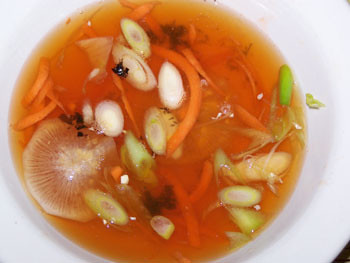
Here are some pictures of some recent meals we've been testing in our kitchen...
Aren't these videos wonderful? Today we have yet another special Raw Spirit interview for you -- the mega-talented Markus Rothkranz. What can I say about Markus? He's a true inspiration, a man who truly lives by his heart and inspires thousands of others on a daily basis. He's actually very tough to interview because he's so interesting and self-actualized, you really just want to hang and chat with him (but then you remember that you're on film and you should probably get back to asking questions that people will appreciate).
And here's the conclusion of Wendi's San Francisco travelogue:
 That evening we met up with Carolyn, a long-time friend since college, who was our lovely host for a few days. Carolyn has a gift with cats, which was a real treat for KDcat to see. Do you know how you can teach dogs to sit and give kisses? Well, Carolyn has taught one of her rescued cats to do the same thing! He *really* sits and *really* gives kisses on command! WOW!
Carolyn showed us all around the San Franciso and Berkeley areas, bringing KDcat to a thrift shop (she's been having fun popping into random thrift shops to see what she can find) and a fun shop called Ancient Ways, stopping by some Indian shops so I could pick up some more bindis and some ground coriander for a dish I made while visiting, checking out the Berkeley campus area, and taking us shopping for organic foods.
Read more: Part 4 of 4: Glowing Gypsy Gals Glimpse the Glorious Golden Gate's Gastronomical Goodness
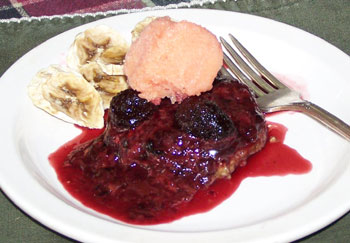
Jim here... Thought I'd post a pic from Wendi's birthday last Friday. Shown above is the "birthday cake" -- more of a birthday treat, really. If it looks decent to you, here's the recipe:
The "cake" part: